Browse the glossary using this index

Special | A | B | C | D | E | F | G | H | I | J | K | L | M | N | O | P | Q | R | S | T | U | V | W | X | Y | Z | ALL

D

dc–ac converter

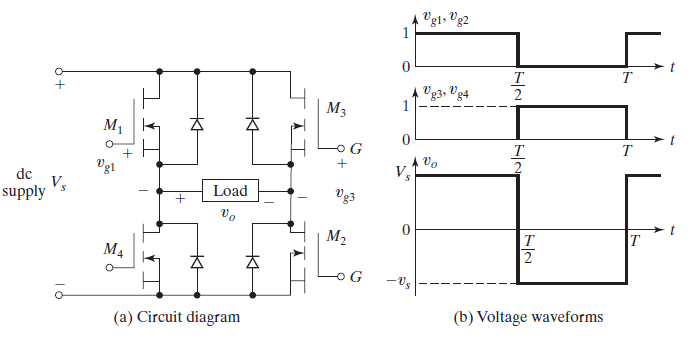
- is also known as an inverter. A singlephase transistor inverter is shown in the figure.

When MOSFETs M1 and M2 are turned on by applying gate voltages, the dc supply voltage Vs appears across the load
and the instantaneous output voltage is Vo = +Vs. Similarly, when MOSFETs M3 and M4 are turned on by applying gate voltages, the dc supply voltage VS appears across the load in the opposite direction. That is, the instantaneous output voltage is Vo = −Vs. If transistors M1 and M2 conduct for one half of a period and M3 and M4 conduct for the other half, the output voltage is of the alternating form. The rms value of the output voltage becomes Vo(rms) = VS. However, the output voltage contains harmonics which could be filtered out before supplying to the load.

image.png


dc–dc converter

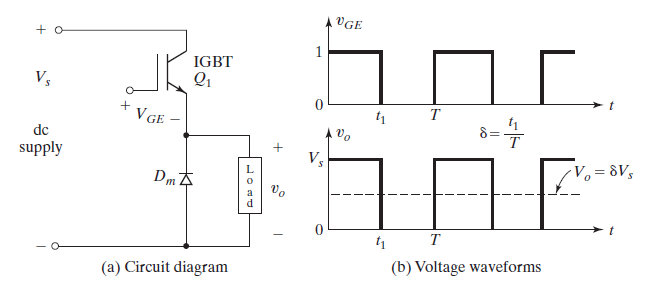
also known as a chopper, or switching regulator, and a transistor chopper

image.png

When transistor Q1 is turned on by applying a gate voltage VGE, the dc supply is connected to the load and the instantaneous output voltage is Vo = +Vs. When transistor Q1 is turned off by removing the gate voltage VGE, the dc supply is disconnected from the load and the instantaneous output voltage is Vo = 0. The average output voltage becomes Vo(AVG) = t1Vs/T = δ Vs. Therefore, the average output voltage can be varied by controlling the duty cycle. The
average output voltage Vo is controlled by varying the conduction time t, of transistor Q1. If T is the chopping period, then t1 = δT. δ is known as the duty cycle of the chopper.


diode rectifier

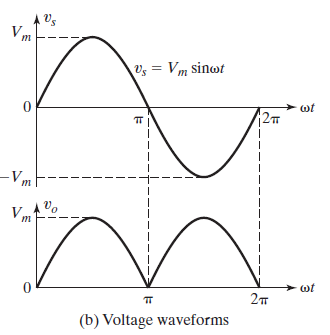
- circuit converts ac voltage into a fixed dc voltage

  • diode conducts when its anode voltage is higher than the cathode voltage, and it offers a very small voltage drop, ideally zero voltage, but typically 0.7 V. A diode behaves as an open circuit when its cathode voltage is higher than the anode voltage, and it offers a very high resistance, ideally infinite resistance, but typically 10 kΩ. The output voltage is a pulsating dc, but it is distorted

image.png image%20%281%29.png